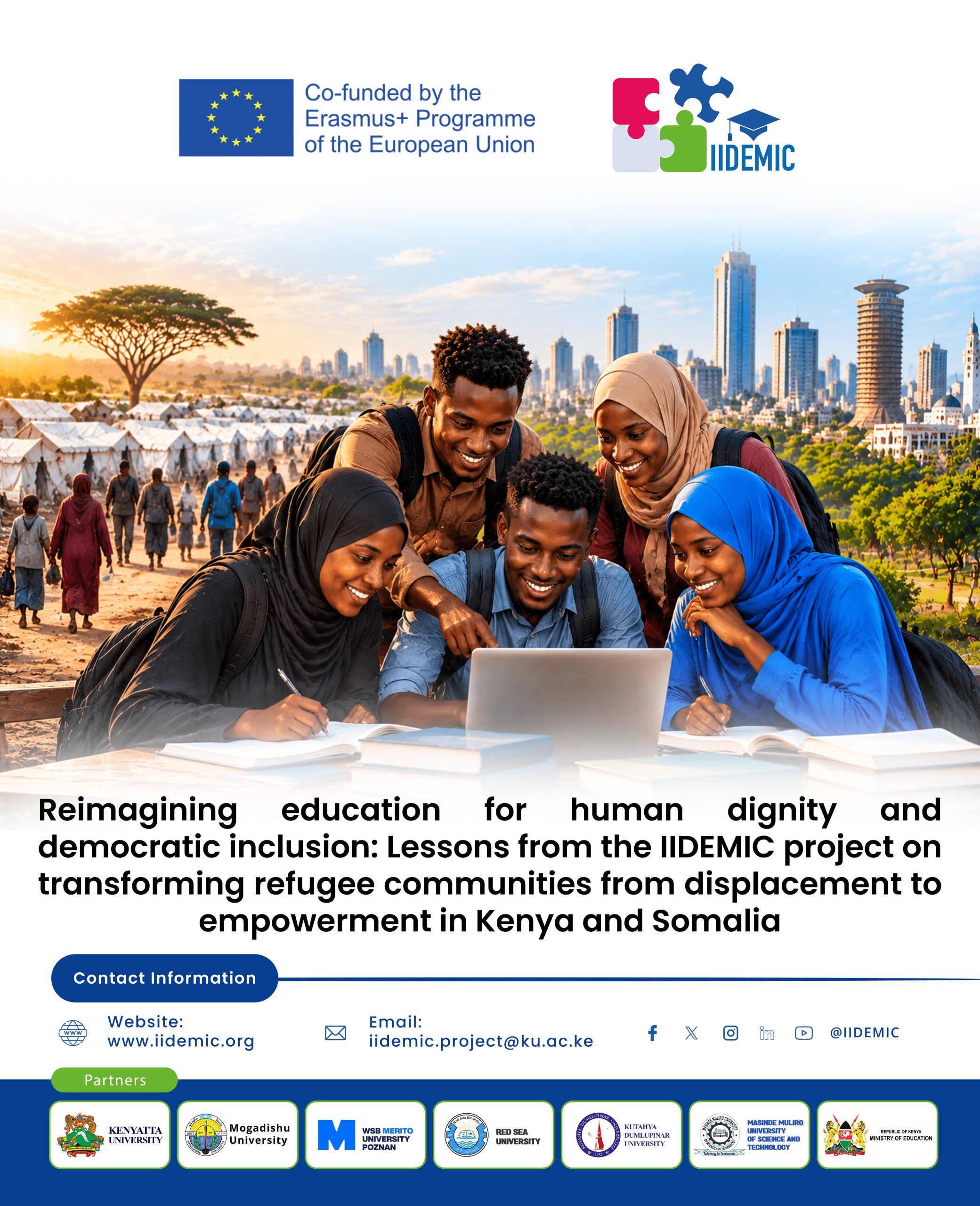
Reimagining education for human dignity and democratic inclusion: Lessons from the IIDEMIC project on transforming refugee communities from displacement to empowerment in Kenya and Somalia
Authors:
- Marguerite Miheso O’Connor, Kenyatta University
- Adelheid Bwire, Kenyatta University
- Francis Mwangi, Kenyatta University
- Priscilla Ndegwa, Kenyatta University
- Beatrice Bunyasi, Kenyatta University
- Mildred Nawiri, Kenyatta University
Book of Abstracts
Recreating Democracy: Education as Democratic Hope
International Research Conference on Education and Democracy, 21-22 October 2026
Edited by David Hammer
Linnaeus University, Kalmar/Växjö, 2026
ISBN: 978-91-8082-520-7 (pdf)
© the authors
Published by: The Department of Education and the Department of Media and Journalism, Linnaeus University.
Session 3:2 Paper session
Abstract:
The growing global displacement crisis has intensified the need to rethink education systems beyond humanitarian response frameworks toward approaches that promote human dignity, democratic inclusion, and sustainable empowerment for refugee and migrant communities. This paper examines the transformative potential of the Inclusive and Innovative Digital Education for Migrant Communities (IIDEMIC) Project, a European Union-funded initiative led by Kenyatta University in partnership with institutions working with displaced populations in Kenya and Somalia. The study seeks to explore how inclusive and context-responsive educational interventions can transform refugee communities from states of displacement and vulnerability into empowered participants in democratic and socio-economic life. The study is anchored in Human Dignity Theory, which emphasizes the inherent right of every individual to equitable access to opportunities, and Democratic Inclusion Theory, which advocates participatory educational systems that recognize diversity, agency, and social justice as central to learning processes. These frameworks provide the lens for understanding education as a tool for empowerment rather than mere access provision. Using a qualitative case study research design, the paper draws on project implementation experiences across refugee and internally displaced contexts including Dadaab, Kakuma, Mogadishu, and Bosaso. Data were generated through project documentation analysis, stakeholder engagement reports, training evaluations, and reflective implementation experiences gathered during the execution of the project’s educational interventions. Findings indicate that educational models integrating teacher capacity development, multilingual and culturally responsive pedagogy, digital and assistive technologies, employability-oriented soft skills, and democratic classroom practices significantly enhance learner participation, resilience, identity affirmation, and agency among displaced learners. The study demonstrates that when education systems recognize learners’ languages, cultures, and lived experiences as valuable assets, learning becomes transformative and contributes to social inclusion and community empowerment. The paper concludes that reimagining education through inclusive and democratic frameworks offers a sustainable pathway for transforming refugee communities from displacement toward empowerment, providing important lessons for policymakers and institutions seeking equitable educational futures in increasingly diverse global societies.