
From Needs Assessment to Course Design: How to Create Education That Answers Real Challenges
What trap do e-learning course authors often fall into when picturing what their course will look like? They start by choosing the technology.
It’s a tempting vision. To picture what they are working on, authors want to know: which platform will host the course? How will the videos be edited? Will there be exercises, and if so, what will they look like? More experienced designers may already picture whether they’ll use H5P test questions or more elaborate interactions built in Articulate Storyline. And then there’s the choice of the LMS platform: an open-source solution, or a bespoke platform built specifically for training purposes. Questions about technology can multiply, and all of them are valid, but…
This is not yet the moment to ask about technology
The essence of an instructional designer’s work is to find answers to questions far more important than those about the formats used in an asynchronous e-learning course – questions that are often asked too soon. The questions I ask first are, for example: who will be learning from this course, and under what conditions? These questions felt even more essential in the Erasmus+ project IIDEMIC – Inclusive and Innovative Digital Education for Migrant Communities, addressed to migrant communities, refugees, and internally displaced persons in Kenya and Somalia. One of the project’s main areas is developing teachers’ competencies: digital, social, and related to inclusive education. The project aims to use technology to increase access to education regardless of participants’ circumstances. In practice, this meant designing digital education for an environment very different from the one we usually imagine when designing an academic online course in Europe.
Long before the Moodle platform went live
The first important stage of designing 10 asynchronous e-learning courses began more than two years ago, during a four-day kick-off meeting organized for the project team in Poland. Two full days were devoted solely to discussing the potential audience for the courses. These discussions were expanded and enriched by a report prepared by the academic team from Turkey, examining the needs of communities in the internally displaced persons (IDP) camps of Kakuma, Bosaso, and Dadaab. It quickly became clear that the group would be highly diverse. Teachers work in different communities, lead numerous and varied groups of students, and operate in a multilingual environment. English is widely known among them, but alongside it they also use Swahili, Somali, and local community languages. The device most used to access digital content is far more often a phone than a computer.
Even more important were the infrastructural conditions. Power outages, problems related to the rainy season, poor internet connections, or lack of access to mobile data cannot be treated as exceptional failures. These are real and recurring educational barriers that had to be taken into account already at the course design stage. This changes and determines the way we think about designing the entire learning experience, not just the choice of technology used to deliver it. It is not enough to ask, “Will this activity be engaging?” We also had to ask: Will the participant be able to run it on a phone? How much data will it require? What happens if they lose connection halfway through the learning process? Will they be able to continue once they’re back online?
Interestingly, the later pilot confirmed how important these assumptions were. One of its goals was precisely to test how the solution performed under limited connectivity and in offline mode. Among its strengths were effective mechanisms enabling offline use of content, though limited internet access in some areas remained one of the challenges.
Light doesn’t always mean simple
These technological conditions gave rise to one of the most important design principles: the technology used in the course must not disrupt the learning process. The platform cannot take several minutes to load a page filled with heavy multimedia. Materials should be downloadable, and wherever possible, participants should be able to work with them offline. The system should allow learners to return to where they left off without having to repeat the entire sequence. It turns out that a broken internet connection is often also a broken chain of focus. This is not only a technical problem — it is an additional distraction that pulls attention away from the content. The learner stops concentrating on the topic at hand and starts checking the connection, restarting the material, or searching for the point where they left off. Returning to the task requires re-engaging attention and reconstructing context, and with frequent interruptions, frustration grows along with the risk of abandoning the course altogether. That is why designing a course resilient to connectivity problems is not merely a technical optimization — it is a way of protecting the continuity of the learning process. From this perspective, the way the course structure is planned also becomes significant. Short, self-contained learning units allow participants to complete a small stage of learning before moving on to the next one. If the connection drops, it is easier to return to a specific fragment than to find one’s place again in material lasting several dozen minutes. Modularity and microlearning therefore stop being merely a way to make a course more attractive. Under conditions of unstable internet access, they become part of designing for resilience against disruption. For this reason, the asynchronous courses designed within the IIDEMIC project used the Moodle LMS platform as their core environment, while interactive materials and exercises were prepared in Articulate Rise. Final tests and evaluations were embedded directly as Moodle interactions. All courses, along with access to the training platform after logging in, were hosted within a dedicated project website.
But when I write about the “lightness” of the courses, I don’t mean only technological constraints. Another critically important element of designing the asynchronous learning process is not overwhelming participants with the sheer amount of content available in the course.
This is where Richard Mayer’s cognitive theory of multimedia learning proved helpful. Human capacity to process information is limited. Adding more elements — video, text, animation, graphics, sound — does not automatically make material better, more interesting, or more engaging for the learner. An overload of information delivered through multimedia in a course, or its poor organization, becomes an obstacle rather than a help to the learner.
That is why the video materials in the IIDEMIC project were designed as multimedia interactions just a few minutes long. These included lectures recorded by the course authors themselves, as well as AI-generated avatars of the authors, created using artificial intelligence tools (in this case, HeyGen). The video scripts generated through the tool saved time in adapting the courses to WCAG accessibility standards: they allowed a text version of the content to be created simultaneously, which made it easier to prepare text scripts for the generated videos.
Accessibility is also a matter of language
Another challenge was multilingualism. Materials were first prepared in English, and versions in Swahili and Somali were created afterward. This process made use of automatic translation powered by artificial intelligence tools, but technology was not the final step in the process. Translations were reviewed by teacher-beneficiaries, who could assess whether the generated text genuinely matched the language used by future participants.
This matters because the accessibility of digital education is not simply a matter of meeting technical requirements. Material can be formally accessible while still being difficult to understand, culturally unfamiliar, or full of examples that mean little to its intended audience. One of the fundamental assumptions of the IIDEMIC project is precisely to create online content that reflects local specificity.
The methodology behind the online courses
The greatest challenge turned out to be designing educational activities that would help achieve the project’s main goals: raising the digital competencies of teachers from camps for internally displaced persons, including in the area of inclusive education. The first step was preparing the course syllabi. In them, the authors carefully linked learning outcomes to distance-learning methods and to ways of evaluating asynchronous learning processes. Next came short text-based handbooks, so-called subject-content knowledge materials, and, based on these, scripts for video materials and exercises. All interactions for course participants were designed based on Michael Allen’s CCAF model. Rather than simply asking participants to recall a definition, they were presented with a situation resembling a teacher’s real-life work. They were then given a problem, asked to make a decision, and only afterward given feedback. Feedback plays a crucial role in asynchronous learning. In a sense, it replaces the teacher, who is not physically present with the learner at that moment. Without it, a participant might not understand why their solution was wrong. They might reinforce incorrect reasoning or begin to treat the exercises as a series of meaningless clicks.
Content authors need support too
Designing 10 courses also meant working with a large and diverse team of authors. Team members took part in methodological training twice. They were given a shared, ready-made template according to which they designed their materials and activities.
Support did not end there. Authors could take part in Q&A sessions, during which they worked with the instructional designer to analyze the exercises being developed, correct inaccuracies, solve problems, and look for solutions together. They also checked whether the activities they had prepared genuinely allowed the intended learning outcomes to be achieved. This is especially important for outcomes related to skills. If, after completing a module, a participant is meant to be able to apply something, simply reading a text or watching a video is not enough. They need the opportunity to analyze a situation, make a choice, solve a problem, or practice the given skill. The openness of the author teams from Somalia, Kenya, and Turkey played an important role here. Designing the courses was also an opportunity for them to develop their own methodological competencies and experiment with new tools, including AI solutions used to create video materials and activities.
A course worth coming back to
Good e-learning is designed from the start with the assumption that the learning process does not end after a single pass through the material. Participants can return to the courses, repeat activities, and reinforce their knowledge. Completion requires finishing the course and achieving at least 80% on the final assessment, after which the participant can receive a certificate. The first pilot was conducted on a small scale, so its results should not be treated as definitive proof of the solution’s overall effectiveness. It did, however, provide important information ahead of further implementation — including more than 95% active use of the platform within the pilot group, improved digital navigation skills, and greater confidence among teachers in working with digital technologies.
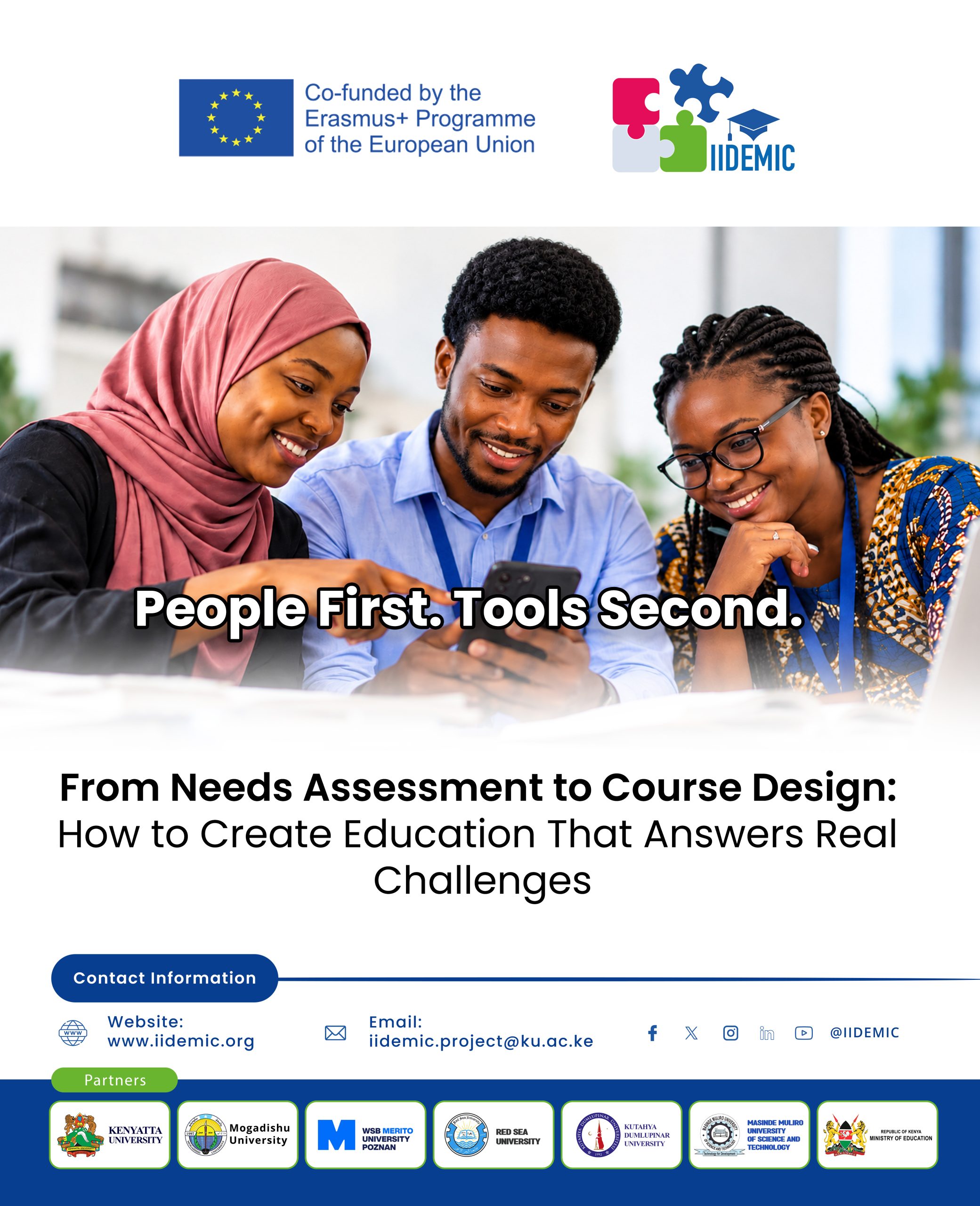
People first, tools second
The experience gathered over several months of designing the courses developed under the IIDEMIC project shows that designing inclusive digital education does not begin with choosing technology. It begins with the human being.
What device will they use? What language do they speak day to day? Do they have a stable internet connection? What happens if they lose access to the network or to power halfway through an exercise? Does the example used in the course make sense in their reality? Will they find out why they made a mistake after answering incorrectly? Will the activities genuinely help them develop the skills they need?
Only the answers to such questions should lead to decisions about which specific technology or type of educational activity to use. Well-designed educational technology should not be the main character of the course. Its job is to remove, as discreetly as possible, the barriers that might otherwise stand in the way of a person’s learning.
Agnieszka Goncerzewicz
UWSB Merito in Poznań
More: https://iidemic.org/